How Do You Know if Its Real Gold
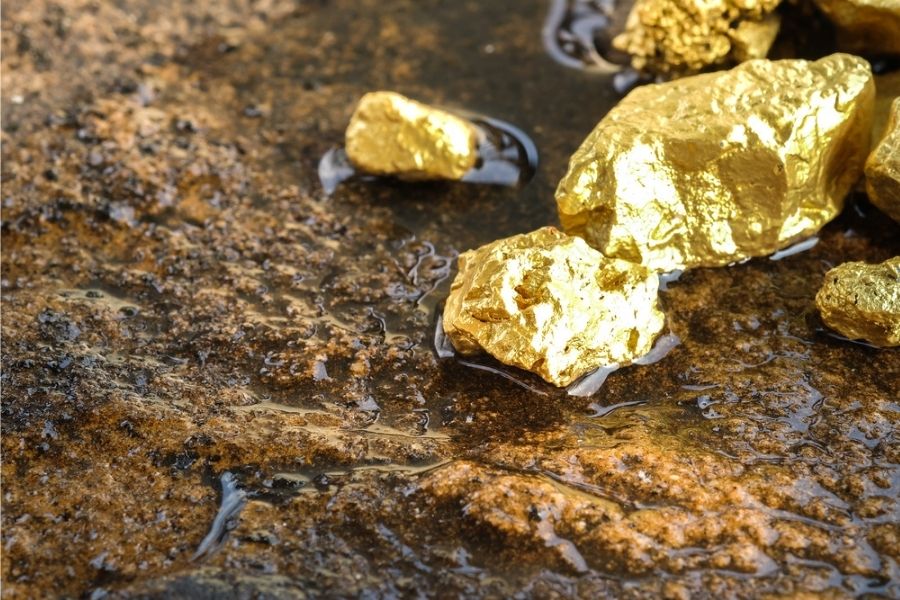
Gilded is the quintessential symbol of status, power, immortality and wealth, oftentimes restricted to royalty.
Accounts differ on when the first gilt mines were dug and operated. Some say information technology all began in three,100 BCE with the ancient Egyptians . Archaeological sites like the over-6,000-yr-old mines of the Asosa region of Ethiopia and the 5,500-year-old Sakdrisi mine of Georgia put the systematic practice of gold mining back several thousands of years before. Some say that in South Africa there are mines that are even older.
The aboriginal Egyptians believed gold was the mankind of the sunday god Ra . Gold is considered luxurious and precious because information technology is beautiful and easy to work. Information technology does not tarnish, rust or dissolve (except by aqua regia, the proper noun for nitrohydrochloric acid, which is used in ane of the tests mentioned below). Gilded is hard to extract: Barely 50 grams come out of a ton of ore. Information technology is as well one of the best electrical conductors, which is why information technology is used so heavily within computers and other technological equipment.
Means TO Exam Golden AUTHENTICITY
This article discusses several tests yous can hands practise at home to help you when you need to know how to tell if gold is real.
The Stamp Examination : Wait for Hallmarks
A piece of gold jewelry is oftentimes engraved with a hallmark, which is a stamp that identifies its content and/or manufacturer. Hallmarks ordinarily appear in an camouflaged place like the within of a ring.
The standard purity scales are based upon karats and millesimal fineness. The authentication exam, also known every bit the magnifying glass test, is a good identify to start when checking if your aureate is real.
Hallmarks include:
- Valid purity numbers under the Karat organization (like 8k, 9k, 10k, 14k, 15k, 18k, 20k, 21k, 22k, 23k, and 24k)
- Valid purity numbers nether the Millesimal Fineness organisation (333, 375, 417, 583 or 585, 625, 750, 833, 875, 916, 958 and 999)
- False purity numbers (anything other than the above)
- Manufacturer (like ESPO for Esposito, etc.)

Hallmarks prove the gold's level of purity and manufacturer to lend greater credibility to a piece's authenticity and to make information technology easier to identify and verify. Since anybody tin engrave whatsoever hallmark they choose, this level of testing is non 100% foolproof
If the numbers say anything other than the ones mentioned in a higher place, then yous have faux gold. For example, 800, 925, and 950 exercise not refer to gold, but to silver. Why would they be put 925 on gold ? Because this oftentimes means the jewelry is gold plated with a sterling argent base.
Some other matter to expect for is whether or not the marks indicate that the value has either been measured in karats or in millesimal fineness. Any other numbers than those above would indicate that the gold is fake.
Not all existent gold jewelry has hallmarks—for case, older pieces may have had original markings that take been worn off.
Look for Letter Markings
Whatsoever gold that is marked less than 10k (41.7% purity) is considered fake.
Anyone who is familiar with the unlike levels of quality volition quickly recognize the following markings:
- GP
- GF
- GE
- GEP
- HGP
- HEG
You volition want to avert the higher up designations if y'all're looking for existent gold. They all indicate gold plating . In the same gild, they mean:
- Aureate Plated
- Gold Filled
- Gold Electroplated
- Gilded Electro Plated
- Heavy Gold Plated
- Heavy Gilded Electroplated
These markings indicate that only a small percent of aureate was used to cover a piece that was made out of another kind of metallic in gild to give it the advent of aureate.
To give you lot an idea of how the upper levels of purity stack upwardly next to 1 another: 24k gold is 99.nine% pure, while 18k gold is 75% pure. Absolutely 100% pure gold is unheard of, mainly because pure aureate is very soft and wouldn't make for a durable piece of jewelry.
The Peel Test

Wait for Bluish or Green Tint on Your Skin
This test is simple: It involves holding a slice of golden jewelry betwixt your hands for a couple of minutes. The perspiration from your hands will either react with the metal and change the color of your skin or leave it unaffected. When real gold is in direct contact with your skin there is no discoloration. If the gold is faux it will crusade your skin to turn black, blueish, or green at the contact points.
Ane exception to this procedure occurs if you examination golden on your pare while wearing a liquid foundation. When gold touches the makeup it will turn your skin black at the points of contact. Removing all makeup before testing makes this test more than reliable.
Alternatively, makeup can besides be used to test for gold authenticity. Put on a liquid foundation and add together pulverisation over it. Once the makeup has stale, press the piece of jewelry confronting your skin and so run it lightly over your peel where you have the makeup. If the jewelry leaves a black track on the makeup, you probably have real gold.
Aureate is extremely nonreactive, so existent gilded jewelry will never discolor your skin. Only using the makeup test is a unique way to also check if information technology's real.
If in that location are discolorations in gold jewelry information technology means you have an blend where at that place are other metals mixed in.
The Size and Weight Test
This test works well on coins and bars. You lot can
- Compare a slice of aureate you want to test with one that is already known to be real
- Apply a set of calipers and a jeweler's scale or use a Fisch Tester
Gold is denser than most other metals. If you have a slice that looks too large for its weight or feels likewise low-cal for its size, then yous probably accept fake gilt.
Bullion coins are actual coins fabricated from precious metals, including gilded, silver, palladium, or platinum. They serve every bit collectibles, investments, or every bit a hedge against inflation .
The Magnet Test
Hold a stiff magnet side by side to a piece of gold and watch for a reaction. Golden is non magnetic, so there should non be any attraction to magnets. If there is, you most likely don't have real gilded.
Even so, some of the base of operations metals that tin be mixed with gilt are too not-magnetic so you tin get a fake read. The test isn't foolproof so it's a good idea to practice this in conjunction with another more accurate testing method.
The Float Test
Only drop the piece into a container of h2o. Gold is dense. If information technology doesn't float at all or hover over the bottom of the container, y'all could maybe have existent gilt.
The Ceramic Scratch Examination

Take an unglazed ceramic plate or piece of tile and scrape a piece of gold beyond its surface. Real gold volition leave a gold marker or trail. Other metals will leave a blackness trail.
The Water Examination (a.thou.a. The Density Test)
This is done past calculation. You need
- A scale (to weigh the jewelry)
- A container of water and
- A way to measure out the level in millimeters (to measure the water levels before and subsequently the jewelry goes into the water)
At present do the calculation: decrease the "before" measurement from the "after" measurement. And so divide the weight of the jewelry by the difference in the h2o levels.
This gives you the density.
The standard density of existent gold is nineteen.3 grams per milliliter (also written 19.3g/mL). Not a lot of other metals come up very close to it. If your adding gives this figure or something very close to it, you probably have real gold.
When you use density to distinguish gold's authenticity, you also need to keep in mind that there tin be differences in density betwixt different types of gilt.
For case, the purer the aureate, the heavier it will be--and white golden is heavier than yellowish. Therefore, the density of gold betwixt 14k and 22k volition be anywhere betwixt around 12.9 and 17.7 for xanthous aureate and anywhere between around 14 and 17.8g/mL for white golden.
The Acid Tests

Vinegar Examination
This examination simply requires that a few drops of vinegar be applied to the metal, hopefully in an inconspicuous place.
If the metal is real gold there will exist no alter. If the metallic is fake aureate it will change color.
The Nitric Acid Test
Gold is a noble metal which means its resistant to corrosion, oxidation and acid. To perform this test, rub your gold on a black stone to leave a visible mark. Then apply nitric acid to the mark.
The acrid volition dissolve any base metals that aren't real gold.
If the mark remains, apply nitrohydrochloric acid, also called aqua regia (75% nitric acid and 25% hydrochloric acrid) to the mark. This mixture dissolves aureate and so, if the mark disappears, the gilded is real.
The Machine Tests
Electronic Tester (i.e Sigma Metalytics Machine)
The Sigma Metalytics Precious Metal Verifier is calibrated for accuracy on a minute calibration, enabling information technology to distinguish between metals in less than one 2nd. While this equipment is proficient for measuring bullion and coins, Sigma Metalytics recommends the Kee Gold Tester for testing jewelry.
This machine sends electromagnetic waves into the item, passing through surface materials like wrapping or plating to read the resistance of the underlying metal. Its meter display is set to show a specific range of resistance that is or is not consequent with the resistance of each metal the machine has been calibrated to detect.
XRF Spectrometer
This car works by sending X-rays through the golden and exciting its atoms into a college energy country.
When the excited atoms return to normal they requite off radiation. The machine monitors and analyzes this, using the radiation reading to identify the material. This method is fast and accurate. It is precise and far outperforms other methods while doing no damage to the items being tested.
In fact, none of these methods causes chemic or mechanical damage, so they will not jeopardize the value or integrity of your piece.
The Neglect-Safe Test

If y'all really want to know for sure how much gold is really in your gold, the most tried-and-true method of finding out is to have it to a reputable jeweler and have it tested at that place.
Jewelers have a broad array of methods available to the public for authentication of gold content. Of form, cipher beats experience. But those who are trying to pass lesser metals off every bit existent gold having become increasingly sophisticated in their "arts and crafts," so fifty-fifty the jeweler will probably resort to machine verification to make sure.
Most home tests can requite yous an idea of whether or non your gold is real. While they are all expert at showing probability, none are 100% conclusive.
The best manner to know for sure if your gold is real is to have an experienced and reputable jeweler evaluate it for you.
Delight experience complimentary to share this article with anyone you lot know who could benefit from the data and caveats information technology contains.
How Do You Know if Its Real Gold
Source: https://lexiejordanjewelry.com/blogs/posts/how-to-tell-gold-is-real
0 Response to "How Do You Know if Its Real Gold"
Post a Comment